Sep 25, 2008
Guide dog allowed in mosque
Ruling by Muslim body hailed as a breakthrough
LONDON - A BRITISH Muslim body has ruled that a blind student can take a guide dog with him to his local mosque, a judgment Muslim and blind advocacy groups are hailing as a breakthrough.
The Muslim Law Council (Shariah) UK issued a fatwa allowing 18-year-old Mahomed-Abraar Khatri to take his dog with him to the Bilal Jamia Mosque in the English city of Leicester, about 160km north of London.
'I hope it will open up some doors and let other people to get a dog and not be worried of any religious aspects behind it,' Mr Khatri told British Broadcasting Corporation (BBC) television in an interview broadcast on Wednesday.
Observant Muslims generally regard dogs as unclean and they are not allowed in mosques. It was not immediately clear whether this was the first time a dog has been allowed in a British mosque, or whether the move had any precedent elsewhere.
Mr Ahmed Rehab, a spokesman for the US-based Council on American Islamic Relations, said he had never heard of any similar incident in the United States.
The fatwa does not allow the dog into the prayer hall itself. Instead, Mr Khatri can leave it in a gated area in the entryway near where the shoes are kept.
BBC television footage showed Mr Khatri ushering his yellow Labrador, Vargo, into the enclosure.
The Muslim Council of Britain, an umbrella group of UK Muslim organisations, said it was pleased with the ruling.
'The scholars who have deliberated this ruling have explored the issue from all angles and we are delighted with their fatwa,' MCB Assistant Secretary-General Shaykh Ibrahim Mogra said.
The Guide Dogs for the Blind Association described the decision as 'a massive step forward for other blind and partially sighted Muslims'. -- AP
Source: http://www.straitstimes.com/Breaking%2BNews/World/Story/STIStory_282367.html
Showing posts with label World. Show all posts
Showing posts with label World. Show all posts
Thursday, September 25, 2008

Friday, July 11, 2008
Beautiful story
I'm not a sports fan (though I don't mind ogling at sportsmen/sportswomen with Ooh-la-la~! physiques :P), but I love this beautiful story, which perhaps reflects the true spirit of the Olympics.
ST 11 July 2008
A continuing series on memorable Olympic stories. Tomorrow: Persistence
Sportsmanship: Jesse Owens & Lutz Long
'Hitler must have gone crazy watching us embrace'
By Rohit Brijnath
A GREAT long jumper is struggling to qualify for an Olympic final. A rival steps in to help him. It seems at best a nice gesture, an old-fashioned extending of a hand of decency, nothing more than that.
But it is much more than that, which is why for 72 years people continue to resurrect this story as an example of Olympic man at his best.
Jesse Owens, the jumper who was struggling, was an athletic genius. He was also black. It should not have mattered but of course it did.
It mattered in America, where he often ate breakfast in the car because he was not allowed into many restaurants.
And it mattered in Germany in 1936, when Adolf Hitler was propagating his despicable theories of the superiority of the Aryan race, and when in some newspapers, pictures of an ape appeared alongside Owens.

24-CARAT FRIENDSHIP: German Lutz Long's (left) generous gesture towards American Jesse Owens was a moment of beauty in a time of ugliness at the 1936 Olympic Games. -- PHOTO: AFP
On the day of the long jump, Owens ambled down the runway in practice and casually ran into the pit - only to be horrified when the judges considered it a qualifying jump and raised the red flag for a foul.
Suddenly, only two qualifying jumps remained.
Owens again overstepped the take-off board. Foul.
One jump remained.
Lutz Long, a gifted German long jumper, was blond, blue-eyed and the archetypal Aryan. Owens was his opponent and the better jumper. Still, in an act of startling generosity, the German approached the American and pointed out that the qualifying mark was so easy that if Owens took off from behind the board he would still make the final.
Owens listened, took off from a foot behind the take-off board, and qualified.
Then the two men duelled in the final. Owens led. Long equalled him. Hitler applauded. But Owens was too good eventually, and when he broke the Olympic record with his last leap, Long was the first to embrace him.
Owens understood immediately the enormity of the German's gesture, a moment of beauty in a time of ugliness.
'It took a lot of courage for him to befriend me in front of Hitler,' the American said later.
'You can melt down all the medals and cups I have and they wouldn't be a plating on the 24-carat friendship I felt for Lutz Long at that moment. Hitler must have gone crazy watching us embrace.'
Long died in the war, but the story had one remarkable postscript recounted in Donald McRae's brilliant book, In Black And White.
In 1951, Owens returned to Berlin and to the Olympic Stadium, and in the dressing room later, a young boy asked him to autograph a scrapbook.
As Owens scrawled his name, he noticed a familiar picture. He took the scrapbook and said: 'That's Lutz Long.'
And the boy, Karl, looked at him and said: 'My father, sir.'
ST 11 July 2008
A continuing series on memorable Olympic stories. Tomorrow: Persistence
Sportsmanship: Jesse Owens & Lutz Long
'Hitler must have gone crazy watching us embrace'
By Rohit Brijnath
A GREAT long jumper is struggling to qualify for an Olympic final. A rival steps in to help him. It seems at best a nice gesture, an old-fashioned extending of a hand of decency, nothing more than that.
But it is much more than that, which is why for 72 years people continue to resurrect this story as an example of Olympic man at his best.
Jesse Owens, the jumper who was struggling, was an athletic genius. He was also black. It should not have mattered but of course it did.
It mattered in America, where he often ate breakfast in the car because he was not allowed into many restaurants.
And it mattered in Germany in 1936, when Adolf Hitler was propagating his despicable theories of the superiority of the Aryan race, and when in some newspapers, pictures of an ape appeared alongside Owens.
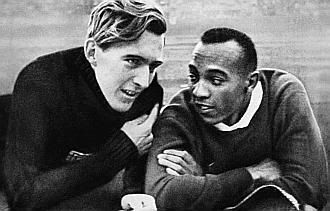
24-CARAT FRIENDSHIP: German Lutz Long's (left) generous gesture towards American Jesse Owens was a moment of beauty in a time of ugliness at the 1936 Olympic Games. -- PHOTO: AFP
On the day of the long jump, Owens ambled down the runway in practice and casually ran into the pit - only to be horrified when the judges considered it a qualifying jump and raised the red flag for a foul.
Suddenly, only two qualifying jumps remained.
Owens again overstepped the take-off board. Foul.
One jump remained.
Lutz Long, a gifted German long jumper, was blond, blue-eyed and the archetypal Aryan. Owens was his opponent and the better jumper. Still, in an act of startling generosity, the German approached the American and pointed out that the qualifying mark was so easy that if Owens took off from behind the board he would still make the final.
Owens listened, took off from a foot behind the take-off board, and qualified.
Then the two men duelled in the final. Owens led. Long equalled him. Hitler applauded. But Owens was too good eventually, and when he broke the Olympic record with his last leap, Long was the first to embrace him.
Owens understood immediately the enormity of the German's gesture, a moment of beauty in a time of ugliness.
'It took a lot of courage for him to befriend me in front of Hitler,' the American said later.
'You can melt down all the medals and cups I have and they wouldn't be a plating on the 24-carat friendship I felt for Lutz Long at that moment. Hitler must have gone crazy watching us embrace.'
Long died in the war, but the story had one remarkable postscript recounted in Donald McRae's brilliant book, In Black And White.
In 1951, Owens returned to Berlin and to the Olympic Stadium, and in the dressing room later, a young boy asked him to autograph a scrapbook.
As Owens scrawled his name, he noticed a familiar picture. He took the scrapbook and said: 'That's Lutz Long.'
And the boy, Karl, looked at him and said: 'My father, sir.'
Wednesday, April 23, 2008
Biodiversity loss will lead to sick world: experts
"We are creating an illusion that everything is fine, and we are getting richer and richer. But we're doing it at the expense of our children and grandchildren... all in the name of economic growth and progress."
- David Suzuki, a Canadian scientist and environmental activist, on environmental degradation resulting from the world's heavy focus on economic progress

- David Suzuki, a Canadian scientist and environmental activist, on environmental degradation resulting from the world's heavy focus on economic progress

SINGAPORE (AFP) - - The world risks wiping out a new generation of antibiotics and cures for diseases if it fails to reverse the extinction of thousands of plant and animal species, experts warned Wednesday.
Biodiversity loss has reached alarming levels, and disappearing with it are the secrets to finding treatments for pain, infections and a wide array of ailments such as cancer, they said, citing the findings of a coming book.
Achim Steiner, executive director of the United Nations Environment Programme (UNEP), said more than 16,000 known species are threatened with extinction, but the number could be more.
"We must do something about what is happening to biodiversity," he said at a news conference on the sidelines of the UN-backed Business for the Environment conference.
"Societies depend on nature for treating diseases. Health systems over human history have their foundation on animal and plant products that are used for treatment."
Technological revolution in the 19th and 20th centuries took the focus on finding cures away from nature as pharmaceutical companies relied on technical components to make medicines, he said.
These companies are increasingly turning back to nature as they run out of chemical combinations, he said.
But the world is "losing the intellectual patents of nature before we even have the chance to understand or unravel them," Steiner said.
"This is the tragedy of not understanding biodiversity," he said, adding it would be a "big fallacy" to think that biodiversity is not linked to the phenomenon of climate change.
The book, previewed at the conference, cited the example of the southern gastric brooding frog discovered in the rainforests of Australia in the 1980s. It has since become extinct.
Research on those frogs could have led to new insights into preventing and treating human peptic ulcers which affect 25 million people in the United States alone, according to the authors of the book, "Sustaining Life".
Valuable medical secrets which the frogs held "are now gone forever," the book's key authors, Eric Chivian and Aaron Bernstein, were quoted as saying in a press statement.
The book contains a chapter describing how seven threatened groups of organisms -- amphibians, bears, cone snails, sharks, non-human primates, gymnosperms and horseshoe crabs -- can be valuable in finding cures for diseases.
The Panamanian poison frog, for example, can make pumiliotoxins that may lead to medicines for heart disease, while alkaloids from the Ecuadorian poison frog could be a source for painkillers, it says.
Cone snails produce a compound which has been shown in clinical trials to be a pain reliever for advanced cancer and AIDS patients, according to the book.
David Suzuki, a Canadian scientist and environmental activist, blamed environmental degradation on the world's heavy focus on economic progress.
"We are creating an illusion that everything is fine, and we are getting richer and richer. But we're doing it at the expense of our children and grandchildren... all in the name of economic growth and progress," he said in a keynote address via videoconference.
One solution will be to "take our eyes off the economy," he suggested.
"The real bottom line is clean air, clean water, clean soil that gives us our food, clean energy that comes from the sun, and biodiversity. These are ultimately the most important needs that we have to fight for at all cost."
Hundreds of international business executives, government officials, environmentalists and others have gathered for conference.
It was organised by the UNEP and the UN's Global Compact, an initiative which brings companies together with the UN and other agencies to support environmental and social principles.
Thursday, April 17, 2008
HRH - The queen (part 2)

Speaking of queen + Cleopatra + fans, here's Cleopatra, Queen of the Nile, complete with fans and servants! :)
It seemed like Cleopatra must have had a cat, that there's even a song album titled Cleopatra's Cat by the Spin Doctors.
 That Cleopatra might have owned a cat should not come as a surprise, considering cats were revered and treated as pampered companions in ancient Egytian times, and were often portrayed as Gods in ancient Egyptian paintings.
Read more about Cats in Ancient Egypt
The cat sculpture in the picture is so lovely, if only I had made one during the pottery classes. Ahh, it's too late now.
Anyhow, I was glad to read about my pottery teacher in the Chinese papers recently, though it's a real pity that he will soon have to vacate his home at Seletar to make way for those noisy airplanes.
Maybe we ought to have another party at his house soon, to bid farewell to yet another lovely part of old Singapore that has to be "culled" in the name of economic development.
Haiz...

Friday, December 15, 2006
Paradise?
I had an interesting dream last night, or rather this morning, when I stole a snooze after the alarm clock went off.
I dreamt about the community cats that MIL feeds, and they were all gathered at a large compound. More interestingly, there were community dogs as well, together with the cats. Food supply came from a fridge, in which there were cat food, dog food and human food all somewhat mixed together. Among the human food were mei cai (or mui choi in Cantonese) and some stewed mushrooms, which the cats also ate!
 Then came the most interesting part. There was a swimming pool nearby and many people swimming and playing about, with a carnival-like atmosphere. Everybody was playing or swimming, including the dogs, who were swimming alongside the humans, or with humans clinging onto them in the pool in a playful manner.
All in all, cats, dogs and human beings were living, playing and co-surviving together in a happy community.
~ The End ~
Happy weekend, everyone!
ps: Does anybody know how to cook a meatless version of the Hakka mui choi (preserved mustard) dish? I would like to have the receipe. :)
 C'mon in...the water's fine, even if you're a cat ...or a dog!
 Uhh...ok, if you say so.
Maaa-mmiii...!!!
 I'm so tired after that swim...ZZzzzz...
I dreamt about the community cats that MIL feeds, and they were all gathered at a large compound. More interestingly, there were community dogs as well, together with the cats. Food supply came from a fridge, in which there were cat food, dog food and human food all somewhat mixed together. Among the human food were mei cai (or mui choi in Cantonese) and some stewed mushrooms, which the cats also ate!
 Then came the most interesting part. There was a swimming pool nearby and many people swimming and playing about, with a carnival-like atmosphere. Everybody was playing or swimming, including the dogs, who were swimming alongside the humans, or with humans clinging onto them in the pool in a playful manner.
All in all, cats, dogs and human beings were living, playing and co-surviving together in a happy community.
~ The End ~
Happy weekend, everyone!
ps: Does anybody know how to cook a meatless version of the Hakka mui choi (preserved mustard) dish? I would like to have the receipe. :)
 C'mon in...the water's fine, even if you're a cat ...or a dog!
 Uhh...ok, if you say so.
Maaa-mmiii...!!!
 I'm so tired after that swim...ZZzzzz...
Thursday, December 07, 2006
Putting things in perspective
I have often thought that in the whole scheme of things, whatever problems that come into our lives, no matter how severe and difficult they seemed at the time -- they are so minicule compared to the problems that are happening in the world. I use this line of thinking as a sort of consolation to myself, especially during frustrating / trying times.
So, as a further reminder to myself, I'm posting this which I'd got from san, who got it from wildrun who got it via nio's blog!
Click on the website's video link (on page 1) to view the astounding video.

So, as a further reminder to myself, I'm posting this which I'd got from san, who got it from wildrun who got it via nio's blog!
Click on the website's video link (on page 1) to view the astounding video.
In other news, the past few days at work had been very tense. I've had to report early to work, work late and hardly had a moment to relax. Then worse things happened: I found out that an uncle has liver cancer and given about 6 months to live, and slightly more shockingly, Fatty Blackie had been put to sleep a couple of weeks' ago.
A week before my neighbour went on vacation, she'd asked me to look in on Fatty Blackie during her vacation period, and I said ok. This is the dedicated neighbour who had been taking care of the community cats way before I'd moved into the estate. One day before she went away, she'd called me to remind me to look out for Yoda as well, but at that point, she did not tell me that Fatty Blackie had been put to sleep at the vet. So for the past 1.5 weeks, I had been looking for Fatty Blackie to no avail. I'd only found out about it recently from another very upset cat-feeder. Apparently, it was my neighbour who made the decision to euthanise Fatty Blackie.
You know what? All these things and discoveries - I found out on my birthday. After all that discovery, my mind which was almost brain-dead from work, turned totally blank. So you can say that I had an unforgettable birthday, in a way. :-/
I guess... my neighbour must have her own reasons for making that difficult decision...
Monday, November 20, 2006
Back from holiday
It's back to work for me today, despite not sleeping enough since the body hasn't quite adjusted to local sleeping hours. I woke up at 3am last night, after less than 3 hrs of sleep, and wondered if I should get up to do something or just lie in bed trying to sleep. I finally dozed off after 5am and here I am now, trying not to doze off at the office!
Overall, it's an enjoyable trip, considering it's the first time the SO and I took a packaged tour. A few interesting observations about Europe:
1. Most European countries has a designated bicycle lane on the roads and cyclist has as much rights, if not more, than motorists. Austria even has a special statue dedicated to cyclists, all of which left Uncle S and I salivating...
2. Dog food is dirt cheap (by their local living standards), at less than 1 Euro for an extra large can, so by deduction, I think cat food must be cheap too, although it's not as common on the shelves. (1 Euro = around S$2)
3. Dogs can go anywhere in most of Europe, such as the shops, deli, restaurants, the departmental stores, etc. along with their owners. I've seen big dogs that aren't even leashed. It's lovely to see such wide acceptance of dogs as part of the humans' daily life. Some beggars even have a dog with them, usually sleeping in the owner's laps.
4. One needs to bring very little tissue paper to Europe, that's because:
(a) our oily skin becomes dry, so there's less need to dab on the oily t-zone
(b) the toilets are all very clean and well-equipped with tissue paper, whether or not one needs to pay to use the toilets (cost ranging from 0.40 Euro to 1 Pound). At 1 British Pound to about S$3, this means it can cost S$1.50 just to use the public toilet in London ! However, we did manage to use a free public toilet near the Tower of London, which also provided warm tap water to wash our hands, although the square pieces of toilet paper was funny, and waxy enough to line baking trays for cakes...haha!
5. About toilets, I was very impressed by the automatic-rotating-self-cleaning toilet seat in Germany's public toilets, that I managed to snap a photo hastily. And don't think the public toilets in France have spoiled light bulbs...each toilet cubicle actually has its own light switch, so one needs to turn on/off the light everytime.
We saw a few cats too, although understandably, they weren't as obvious as dogs in the cities. Those cats we saw were outdoors, well-fed and happily roaming about in freedom. I do think these cats have a pretty good life. :)
For now, it's back to the daily grind...
Overall, it's an enjoyable trip, considering it's the first time the SO and I took a packaged tour. A few interesting observations about Europe:
1. Most European countries has a designated bicycle lane on the roads and cyclist has as much rights, if not more, than motorists. Austria even has a special statue dedicated to cyclists, all of which left Uncle S and I salivating...
2. Dog food is dirt cheap (by their local living standards), at less than 1 Euro for an extra large can, so by deduction, I think cat food must be cheap too, although it's not as common on the shelves. (1 Euro = around S$2)
3. Dogs can go anywhere in most of Europe, such as the shops, deli, restaurants, the departmental stores, etc. along with their owners. I've seen big dogs that aren't even leashed. It's lovely to see such wide acceptance of dogs as part of the humans' daily life. Some beggars even have a dog with them, usually sleeping in the owner's laps.
4. One needs to bring very little tissue paper to Europe, that's because:
(a) our oily skin becomes dry, so there's less need to dab on the oily t-zone
(b) the toilets are all very clean and well-equipped with tissue paper, whether or not one needs to pay to use the toilets (cost ranging from 0.40 Euro to 1 Pound). At 1 British Pound to about S$3, this means it can cost S$1.50 just to use the public toilet in London ! However, we did manage to use a free public toilet near the Tower of London, which also provided warm tap water to wash our hands, although the square pieces of toilet paper was funny, and waxy enough to line baking trays for cakes...haha!
5. About toilets, I was very impressed by the automatic-rotating-self-cleaning toilet seat in Germany's public toilets, that I managed to snap a photo hastily. And don't think the public toilets in France have spoiled light bulbs...each toilet cubicle actually has its own light switch, so one needs to turn on/off the light everytime.
We saw a few cats too, although understandably, they weren't as obvious as dogs in the cities. Those cats we saw were outdoors, well-fed and happily roaming about in freedom. I do think these cats have a pretty good life. :)
For now, it's back to the daily grind...
Monday, September 04, 2006
Sad news
This was first reported about 3 hrs ago. Being a fan of animal documentaries, I am very shocked and saddened to read about this tragedy.
Crocodile Hunter Steve Irwin killed

BRISBANE, Australia - Steve Irwin, the hugely popular Australian television personality and environmentalist known as the "Crocodile Hunter," was killed Monday by a stingray during a diving expedition. He was 44.
Irwin was filming an underwater documentary on the Great Barrier Reef in northeastern Queensland state when he was stung, Sydney's The Daily Telegraph newspaper reported on its Web site.
He collapsed at Batt Reef, near Low Isle and the resort town of Port Douglas, Queensland state police said in a statement. Port Douglas is about 1,260 miles north of Brisbane, the state capital.
A rescue helicopter rushed to the scene but Irwin had died, the statement said.
Queensland ambulance service spokesman Bob Hamil confirmed that a diver had been killed by a stingray off Lowe Isles Reef and said cause of death appeared to be a "stingray strike to the chest."
Irwin was famous for his enthusiasm for wildlife and his catchword "Crikey!" in his television program "Crocodile Hunter," which was first broadcast in Australia in 1992 and has aired around the world on the Discovery channel.
He rode his image into a feature film, and developed the Australia Zoo as a tourist attraction.
Irwin had received some negative publicity in recent years. In January 2004, he stunned onlookers at the Australia Zoo reptile park by carrying his month-old son into a crocodile pen during a wildlife show. He tucked the infant under one arm while tossing the 13-foot reptile a piece of meat with the other.
Authorities declined to charge Irwin for violating safety regulations.
Later that year, he was accused of getting too close to penguins, a seal and humpback whales in Antarctica while making a documentary. Irwin denied any wrongdoing, and an Australian Environment Department investigation recommended no action be taken.
Irwin was also seen as a vocal critic of wildlife hunts in Australia. The federal government recently dropped plans to allow crocodile safaris for wealthy tourists in the Northern Territory following his vehement objections.
Irwin told the Australian television program "A Current Affair" that "killing one of our beautiful animals in the name of trophy hunting will have a very negative impact on tourism, which scares the living daylights out of me."
He is survived by his American wife Terri, from Eugene, Ore., and their daughter Bindi Sue, 8, and son Bob, who will turn 3 in December.
Foreign Minister Alexander Downer, who used a photograph of his family at Australia Zoo for his official Christmas card last year, hailed Irwin for his work in promoting Australia through projects such as "G'Day LA," an Australian tourism and trade promotion week in Los Angeles in January.
"The minister knew him, was fond of him and was very, very appreciative of all the work he'd done to promote Australia overseas," Downer's spokesman Tony Parkinson said.
Stingrays have flat bodies and tails with serrated spines, which contain venom and can cause cuts and puncture wounds. The creatures are not aggressive and injury usually occurs when a swimmer or diver accidentally steps on one.
Source: Yahoo! news
Crocodile Hunter Steve Irwin killed

BRISBANE, Australia - Steve Irwin, the hugely popular Australian television personality and environmentalist known as the "Crocodile Hunter," was killed Monday by a stingray during a diving expedition. He was 44.
Irwin was filming an underwater documentary on the Great Barrier Reef in northeastern Queensland state when he was stung, Sydney's The Daily Telegraph newspaper reported on its Web site.
He collapsed at Batt Reef, near Low Isle and the resort town of Port Douglas, Queensland state police said in a statement. Port Douglas is about 1,260 miles north of Brisbane, the state capital.
A rescue helicopter rushed to the scene but Irwin had died, the statement said.
Queensland ambulance service spokesman Bob Hamil confirmed that a diver had been killed by a stingray off Lowe Isles Reef and said cause of death appeared to be a "stingray strike to the chest."
Irwin was famous for his enthusiasm for wildlife and his catchword "Crikey!" in his television program "Crocodile Hunter," which was first broadcast in Australia in 1992 and has aired around the world on the Discovery channel.
He rode his image into a feature film, and developed the Australia Zoo as a tourist attraction.
Irwin had received some negative publicity in recent years. In January 2004, he stunned onlookers at the Australia Zoo reptile park by carrying his month-old son into a crocodile pen during a wildlife show. He tucked the infant under one arm while tossing the 13-foot reptile a piece of meat with the other.
Authorities declined to charge Irwin for violating safety regulations.
Later that year, he was accused of getting too close to penguins, a seal and humpback whales in Antarctica while making a documentary. Irwin denied any wrongdoing, and an Australian Environment Department investigation recommended no action be taken.
Irwin was also seen as a vocal critic of wildlife hunts in Australia. The federal government recently dropped plans to allow crocodile safaris for wealthy tourists in the Northern Territory following his vehement objections.
Irwin told the Australian television program "A Current Affair" that "killing one of our beautiful animals in the name of trophy hunting will have a very negative impact on tourism, which scares the living daylights out of me."
He is survived by his American wife Terri, from Eugene, Ore., and their daughter Bindi Sue, 8, and son Bob, who will turn 3 in December.
Foreign Minister Alexander Downer, who used a photograph of his family at Australia Zoo for his official Christmas card last year, hailed Irwin for his work in promoting Australia through projects such as "G'Day LA," an Australian tourism and trade promotion week in Los Angeles in January.
"The minister knew him, was fond of him and was very, very appreciative of all the work he'd done to promote Australia overseas," Downer's spokesman Tony Parkinson said.
Stingrays have flat bodies and tails with serrated spines, which contain venom and can cause cuts and puncture wounds. The creatures are not aggressive and injury usually occurs when a swimmer or diver accidentally steps on one.
Source: Yahoo! news
Subscribe to:
Posts (Atom)
 Atom Feed (xml)